


Lead Ophthalmologist · Cataract and Retina Surgeon
Dr. JD Ferwerda, MD
Dr. JD Ferwerda, MD: Dutch-trained ophthalmologist specialising in cataracts, lens exchange, retinal disease, glaucoma, and AMD.
A sudden red patch on the white of your eye? A subconjunctival haemorrhage — sometimes called a broken blood vessel or a subconjunctival haematoma — can look dramatic, but it is usually a small, painless bleed on the surface of the eye that clears by itself. An examination can confirm the bleeding is superficial, and check for injury or another cause of red eye.

A subconjunctival haemorrhage is usually a small, painless bleed beneath the clear membrane covering the white of the eye. It often looks worse than it is — and in many cases it clears by itself.
A bright-red patch or spot on the white of the eye
Sudden appearance, often noticed by chance
Little or no pain
Mild grittiness, fullness or discomfort
Vision that remains unchanged
A patch that may spread slightly before it begins to fade
Pain, reduced vision, light sensitivity or an eye injury are not typical of a simple
subconjunctival haemorrhage. Seek urgent ophthalmic assessment.

A subconjunctival haemorrhage happens when a tiny blood vessel beneath the conjunctiva breaks, causing blood to collect on the surface of the eye and appear as a bright red patch.
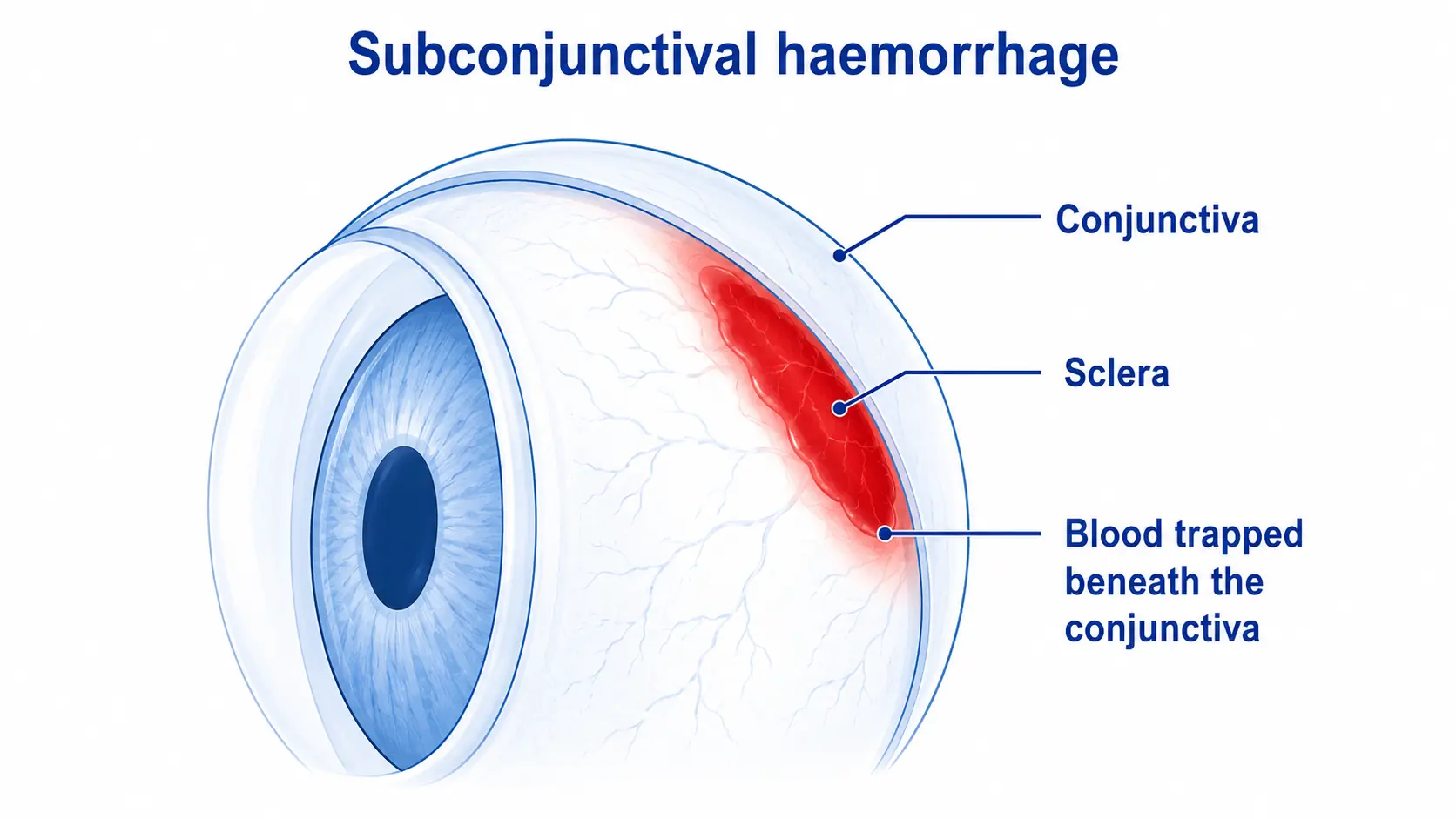
A subconjunctival haemorrhage can appear very suddenly, and may seem to become larger during the first day. The colour then gradually fades as the blood is reabsorbed — much like an ordinary bruise. Because it often causes no other symptoms, it is tempting to assume every red patch is harmless.
Pain, light sensitivity, discharge, swelling or any change in sight should be assessed, rather than attributed to a simple surface bleed.
The bleeding follows an eye injury
Repeated haemorrhages, or unexplained bruising or bleeding elsewhere
You take aspirin, warfarin or another blood thinner, or have a clotting disorder
The redness is worsening, or has not substantially improved after two to three weeks
Eye pain or worsening discomfort, blurred, reduced or double vision, light sensitivity, severe swelling or feeling generally unwell — or a significant injury, chemical splash or suspected foreign body — are not typical of a simple subconjunctival haemorrhage. Do not rub the eye. If a chemical has entered the eye, rinse it continuously with clean water while arranging emergency care.
Severe swelling, marked redness or feeling generally unwell
Eye pain or worsening discomfort
Blurred, reduced or double vision
Sensitivity to light

Your ophthalmologist asks when the redness began and whether there was trauma, coughing, straining, surgery or eye rubbing, then reviews your medicines and relevant medical history. The eye is examined properly — so the reassurance you leave with is real.
For a straightforward, painless surface haemorrhage with normal vision, extensive testing is often unnecessary. If the findings are unusual, further examination or referral may be recommended.

Most uncomplicated subconjunctival haemorrhages do not need a procedure or prescription treatment. The body gradually absorbs the blood, often within one to two weeks; larger bleeds can take two to three weeks.
Do not stop prescribed blood-thinning medication without medical advice.
Dr. JD Ferwerda, MD: Dutch-trained ophthalmologist specialising in cataracts, lens exchange, retinal disease, glaucoma, and AMD.

Russian-trained refractive and general ophthalmologist, leads lasik/ laser vision correction at EEC