

Lead Ophthalmologist · Cataract and Retina Surgeon
Dr. JD Ferwerda, MD
Dr. JD Ferwerda, MD: Dutch-trained ophthalmologist specialising in cataracts, lens exchange, retinal disease, glaucoma, and AMD.
Astigmatism is a common focusing difference caused by the shape of the cornia - or sometimes the lens inside the eye. Instead of focusing light at one precise point, the eye focuses it unevenly, which can make vision look blurred, stretched or slightly smeared at both near and distance.

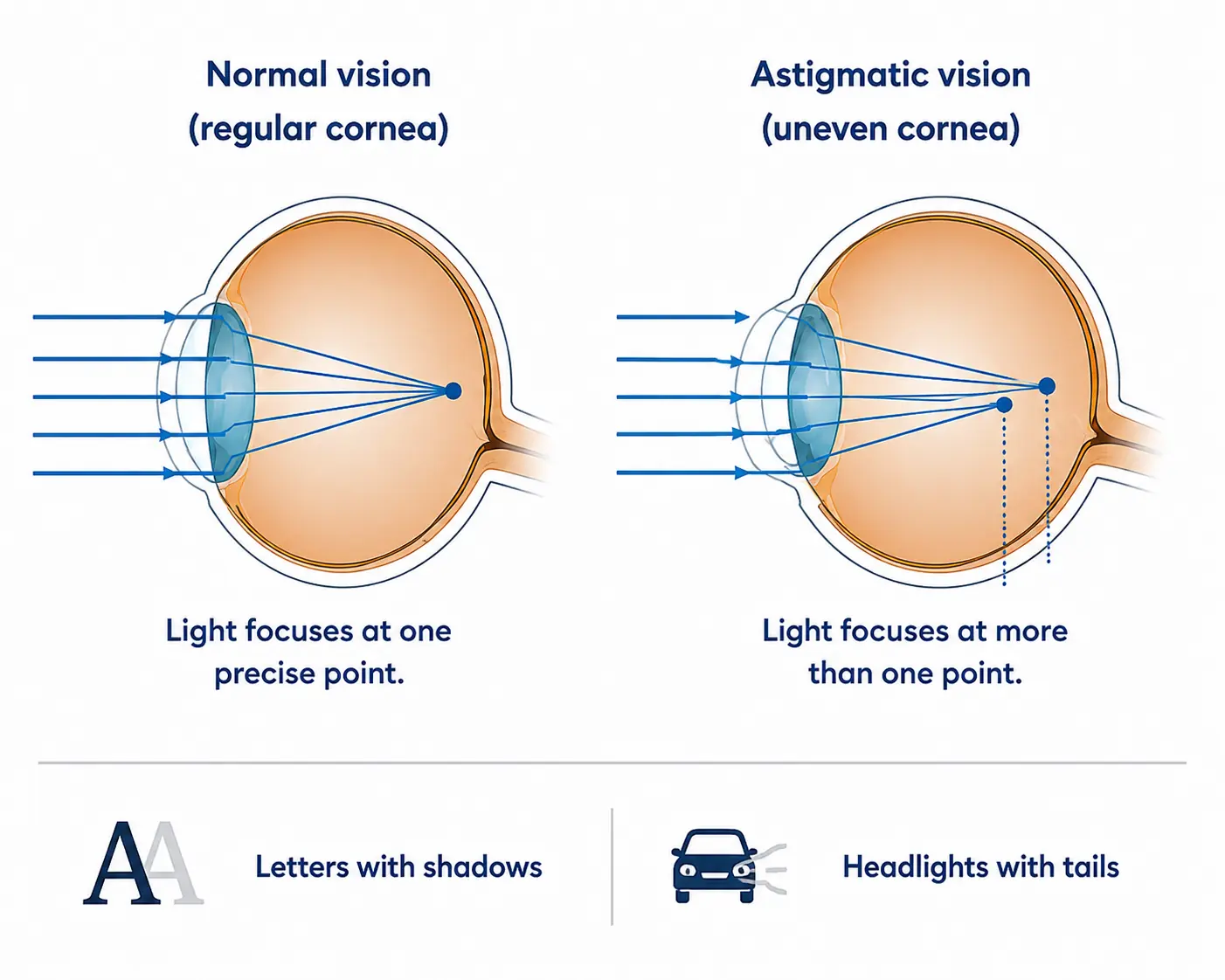
A normally shaped cornea and lens focus light evenly onto the retina. With astigmatism, the curvature differs between directions, so light does not come to one sharp focus.
The result can be blurred or distorted vision at both near and distance. Some people notice only mild blur, while others experience eye strain, headaches, glare or difficulty driving at night. Astigmatism is very common and often occurs together with myopia or hyperopia. Mild astigmatism may cause few or no symptoms.
If blurred vision, eye strain or difficulty seeing at night is affecting daily life, an eye examination can determine whether astigmatism — or another eye condition — is responsible.
Blurred vision at all distances
Distorted or stretched-looking images
Difficulty seeing fine detail clearly
Eye strain during reading or screens
Glare and halos around lights at night
Trouble driving after dark
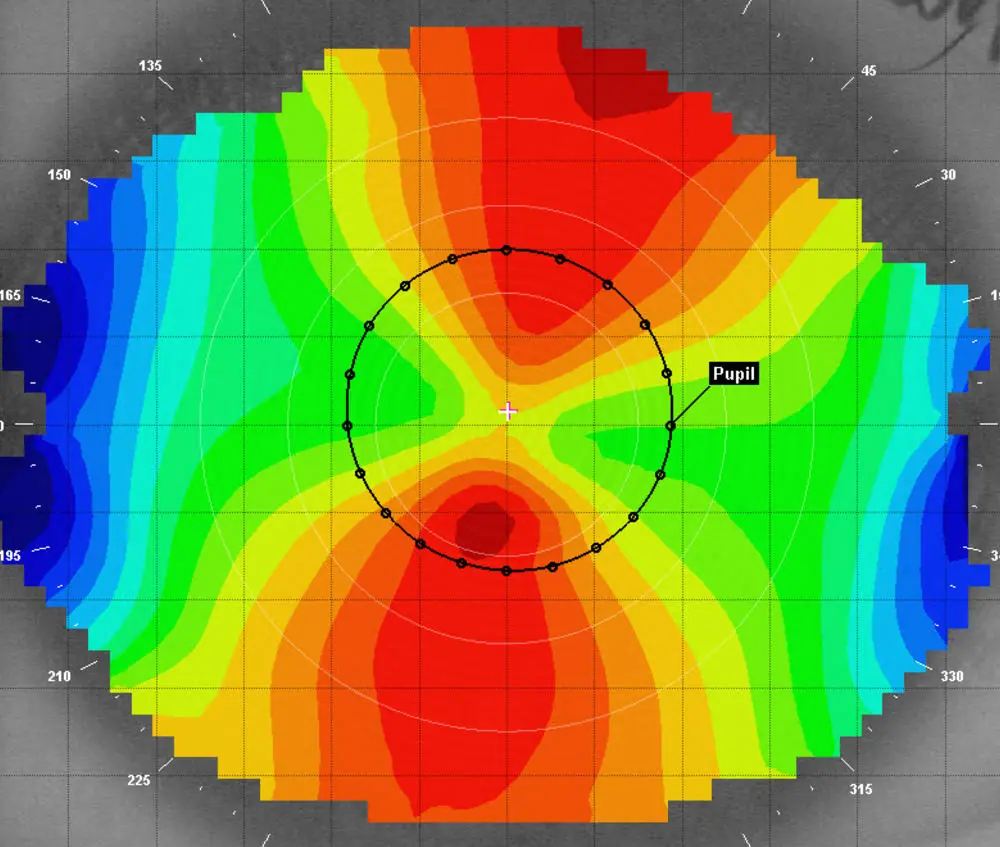
The prescription tells us how much astigmatism you have. The corneal map tells us its shape.
Two people can have similar astigmatism measurements but very different corneal patterns. Most astigmatism is regular and straightforward to correct, while an irregular or changing pattern can sometimes suggest an underlying corneal condition such as keratoconus.
Corneal topography maps the shape of the cornea in detail, helping us distinguish regular astigmatism from patterns that may need closer assessment. It is also useful when planning laser vision correction or cataract surgery.
Glasses
Toric contact lenses
Laser vision correction (when suitable)
Toric intraocular lens (usually for cataract surgery)
We use precise measurements and detailed corneal mapping to understand both the amount and the shape of your astigmatism. This guides the best correction for your vision and helps us plan surgery when needed.
We measure your prescription carefully to determine how much astigmatism is affecting your vision.
Topography shows the surface shape; pachymetry measures the thickness — together they inform correction and planning.
When the pattern suggests risk or change, we rule out or detect keratoconus early.
Detailed mapping supports the best approach for laser correction or cataract lens selection.
Dr. JD Ferwerda, MD: Dutch-trained ophthalmologist specialising in cataracts, lens exchange, retinal disease, glaucoma, and AMD.
Russian-trained refractive and general ophthalmologist, leads lasik/ laser vision correction at EEC